In Japanese martial arts, success in combat often hinges not just on what technique you use, but when you choose to use it. This mastery of timing, developed over centuries of martial tradition, is encapsulated in three fundamental principles: Sen, Go no Sen, and Sen no Sen. These concepts, which can be thought of as initiative in combat, form the backbone of strategic movement in styles like Shito-ryu Karate and extend far beyond simple attack and defence. While they may appear straightforward at first glance – attacking first, countering, or pre-empting – these principles represent increasingly sophisticated levels of martial awareness and tactical thinking. Understanding and applying these concepts transforms basic techniques into effective combat strategies, elevating a practitioner’s ability from mere mechanical reproduction to intuitive mastery.
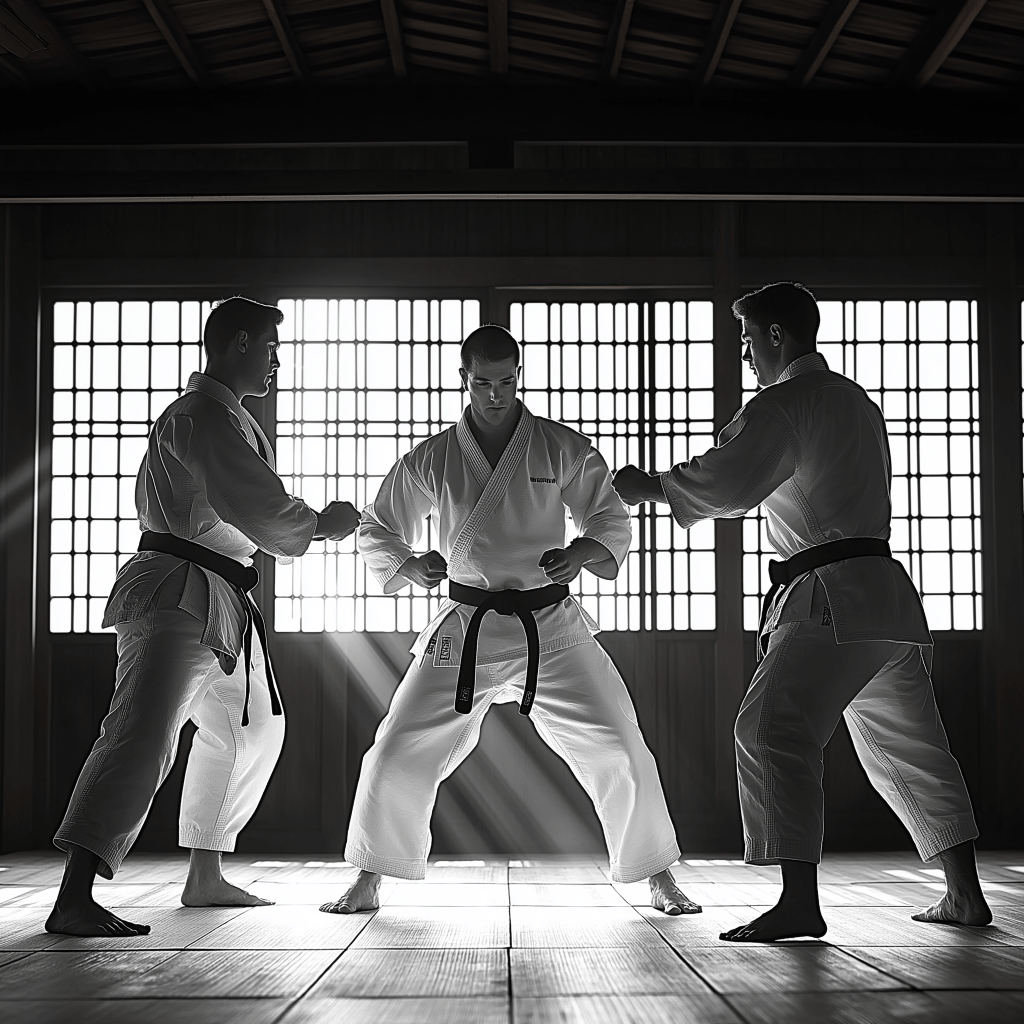
Sen, Go no Sen, and Sen no Sen are fundamental concepts in Japanese martial arts that deal with the timing of defensive and offensive actions. In Shito-ryu Karate, which combines elements of both Naha-te and Shuri-te traditions, these principles are particularly important.
Sen (先) – basic initiative. This is the simplest form of timing, where you take the initiative to attack first. In Shito-ryu, this is often demonstrated through techniques like mae-geri (front kick) or gyaku-zuki (reverse punch) as opening moves. However, pure Sen is considered somewhat basic because it can be predictable and leaves you potentially vulnerable.
Go no Sen (後の先) – late/reactive initiative. This principle involves letting your opponent initiate the attack, then countering. This is often practiced through defensive techniques followed by immediate counters. For example, when an opponent throws a chudan-zuki (middle punch), you might execute a chudan-uke (middle block) followed by a counter-strike. The timing must be precise – you’re essentially stealing your opponent’s momentum and using it against them.
Sen no Sen (先の先) – pre-emptive initiative. This is considered the most advanced of the three principles. In Sen no Sen, you anticipate your opponent’s attack and move at the same moment they begin their technique, essentially intercepting them before their attack can fully develop. In Shito-ryu, this might manifest as a simultaneous block and counter or moving off-line while striking as the opponent begins their movement. This requires precise reading of your opponent’s intentions (yomi) and precise timing.
Underlying all three timing principles is the concept of zanshin (残心) – a state of continued awareness and readiness. Without zanshin, these timing principles become merely mechanical movements rather than effective martial techniques. Zanshin provides the mental foundation that allows a practitioner to effectively choose and execute the appropriate timing principle in any given situation.
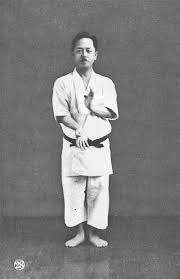
Shito-ryu’s founder, Kenwa Mabuni, emphasised the importance of understanding these principles through both hard (go) and soft (ju) applications. The style’s combination of Shorei-ryu (emphasizing power) and Shorin-ryu (emphasising speed) elements means that these timing principles can be applied with either powerful, direct techniques or lighter, more circular movements.
The development of Sen, Go no Sen, and Sen no Sen follows a specific learning progression that mirrors the traditional martial arts concept of “Shu-Ha-Ri” (守破離) – the stages of learning from rigid adherence to principles, through breaking with convention, to transcendent understanding. This framework helps us understand how to structure training methods effectively:
Initial Phase (Understanding)
- Each timing principle first must be understood in isolation.
- Students develop basic pattern recognition through controlled practice.
- Physical techniques are practiced with deliberate speed to build proper form.
- Mental aspects focus on single-point awareness.
Integration Phase (Application)
- Combinations of timing principles are introduced.
- Speed and power are gradually increased.
- Focus shifts to reading opponent’s intention (yomi).
- Development of peripheral awareness while maintaining centre.
- Introduction of variable timing and rhythm (hyoshi).
Advanced Phase (Intuition)
- Seamless transition between timing principles.
- Development of mushin (無心) – the “no-mind” state where action becomes intuitive.
- Integration of zanshin with natural movement.
- Understanding of maai (間合い) – the relationship between space, time, and opportunity.
This theoretical progression informs how we structure training methods, moving from:
- Isolated practice (kihon) where each principle is trained separately.
- Combined practice where principles are linked together.
- Adaptive practice where principles are applied spontaneously based on circumstance.
The key to this progression is understanding that each timing principle represents not just a physical action, but a mental state and strategic approach. For example:
- Sen requires the mental clarity to recognise opportunities and the confidence to seize them.
- Go no Sen develops patience and the ability to remain calm under pressure.
- Sen no Sen cultivates heightened awareness and the ability to read subtle cues.
In Shito-ryu training, these principles are often practiced through:
- Kihon (basics): understanding the fundamental timing through basic techniques.
- Kata: many Shito-ryu kata contain sequences that demonstrate all three principles.
- Kumite: where these principles are applied in real-time against an opponent.
The goal in Shito-ryu is to master all three principles and know when to apply each one appropriately, rather than relying too heavily on any single approach.
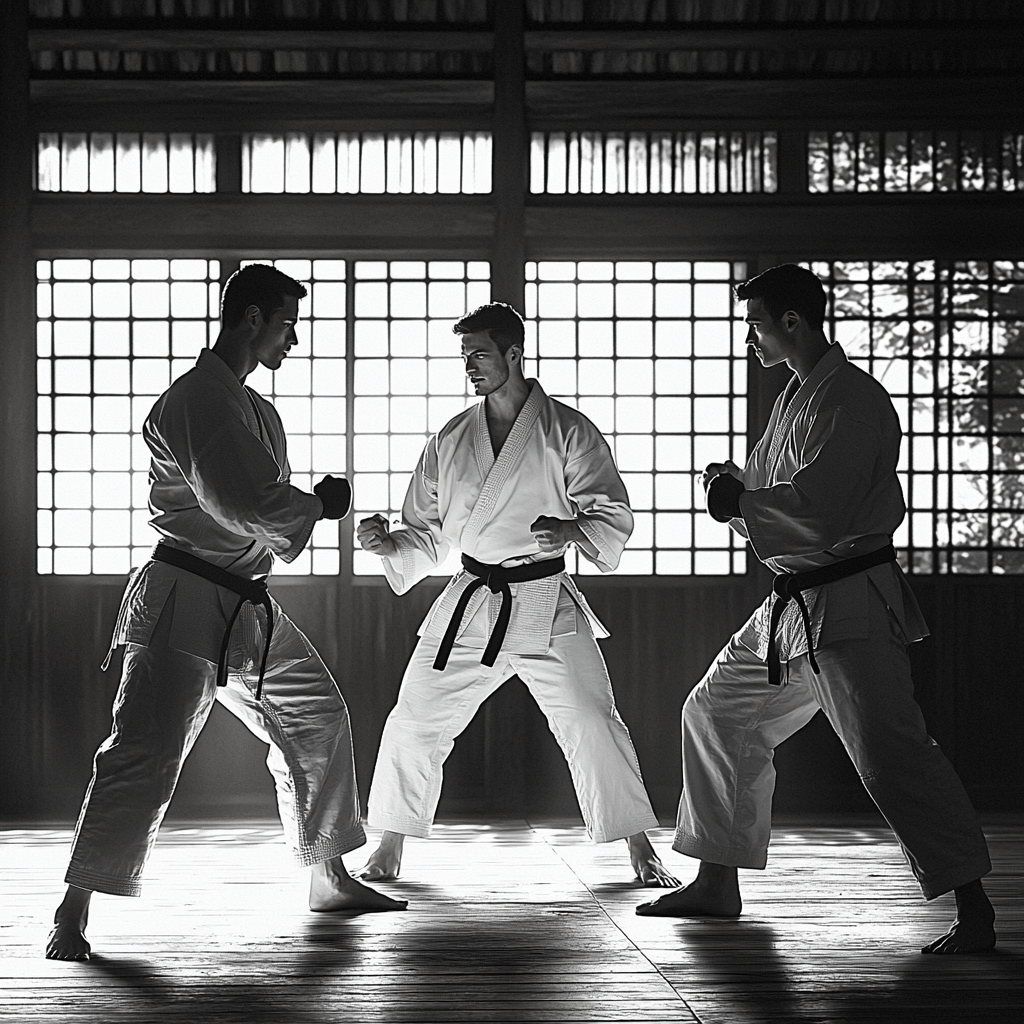
Zanshin (残心) – the state of continued awareness and readiness – is absolutely crucial in mastering Sen, Go no Sen, and Sen no Sen.
In relation to Sen:
- Zanshin ensures that after taking the initiative to attack, you remain aware and prepared for potential counters.
- Without proper zanshin, executing Sen becomes dangerous as you may be vulnerable after your initial attack.
- The maintenance of zanshin helps you assess whether your Sen technique was effective and allows you to adapt if needed.
In Sen no Sen:
- This principle requires the highest level of zanshin as you must maintain constant awareness of your opponent’s subtle movements and intentions.
- Proper zanshin allows you to detect the earliest signs of an attack, making true Sen no Sen possible.
- The maintained awareness helps you adjust your timing and technique during the execution of Sen no Sen.
In Practice:
- Zanshin should be maintained before, during, and after executing techniques.
- It involves both physical and mental aspects: proper posture, breathing, and mental alertness.
- Even in kata practice, zanshin should be maintained as if facing a real opponent.
- The kime (focus) at the end of each technique should be accompanied by continued zanshin.
Without proper zanshin, these timing principles become merely mechanical movements rather than effective martial techniques.
Training methods to improve each of these timing concepts:
Sen Development:
- Practice kihon (basics) with full commitment and power, focusing on clean, direct techniques.
- Use makiwara or pad training to develop confidence in initial attacks.
- Practice stepping drills focusing on explosive movement from a neutral stance.
- Work with a partner on predetermined attack sequences, emphasising proper distance and timing.
- Incorporate reaction drills starting from various kamae.
Go no Sen Improvement:
- Practice blocking drills with immediate counters, gradually increasing speed.
- Work with a partner doing semi-free sparring where you must wait for their attack before countering.
- Use mirror training to improve reaction speed to incoming techniques.
- Practice kata bunkai focusing on the defensive-to-offensive transitions.
- Use multiple attackers in training to develop awareness of timing opportunities.
Sen no Sen Development:
- Practice reading body language through partnered exercises, starting slowly.
- Work on simultaneous block/strike combinations.
- Use slow-motion sparring to develop sensitivity to movement initiation.
- Practice intercepting techniques from various angles and distances.
- Study video analysis of your own movement to identify earlier opportunities for technique application.
Integration Training:
- Practice transitioning between all three timing principles in free sparring.
- Use position sparring where you must apply specific timing principles based on your position.
- Work with senior practitioners who can create realistic attack scenarios.
- Practice kata with different timing emphases to understand how the principles are embedded.
- Use blindfolded sensitivity drills to develop better reading of opponent’s intentions.
Sen, Go no Sen, and Sen no Sen principles can be found within Pinán Nidan (平安二段), also known as Heian Nidan in some styles. To illustrate these principles in practical application, we can examine Pinán Nidan (平安二段), which serves as the first Pinán kata introduced in our style’s curriculum and provides clear examples of all three timing concepts within its sequences.
Sen (Basic Initiative):
- The opening sequence where you step out into nekoashi-dachi with a tetsui-uke movement demonstrates Sen. You’re taking the initiative to establish a defensive position while simultaneously preparing for a counter.
- The double nukite (spear hand) strikes in the kata also demonstrate Sen – they are direct, initial attacks showing basic initiative.
Go no Sen (Reactive Initiative):
- The sequence with the age-uke (rising block) followed by the gyaku-zuki (reverse punch) clearly demonstrates Go no Sen. Here you’re blocking an incoming attack (typically a downward strike) and then countering – a classic example of reactive timing.
- The gedan-barai (downward sweep) followed by gyaku-zuki is another Go no Sen application. The initial movement defends against an attack before launching your counter.
Sen no Sen (Pre-emptive Initiative):
- The age-uke sequence can be applied as Sen no Sen. While often practiced as a block, one bunkai (application) shows it as simultaneously deflecting an incoming attack while striking the opponent’s attacking arm or body – catching them at the very initiation of their movement.
Understanding these principles in Pinán Nidan helps develop proper timing and initiative, which becomes increasingly important in the more advanced Pinán kata.
Japanese martial arts principles, Sen, Go no Sen, and Sen no Sen represent far more than mere tactical options—they embody a comprehensive philosophy of engagement that transcends technical execution. These timing concepts, woven into the fabric of Shito-ryu Karate through both its Naha-te and Shuri-te lineages, provide a framework not only for combat effectiveness but for deeper martial understanding.
The progression from Sen to Go no Sen to Sen no Sen mirrors the traditional learning path of Shu-Ha-Ri—moving from fundamental understanding through practical application to intuitive mastery. This journey is clearly illustrated in kata such as Pinán Nidan, where practitioners can identify and refine these principles through consistent practice. The opening tetsui-uke from nekoashi-dachi demonstrates basic Sen, while the age-uke followed by gyaku-zuki sequences embody Go no Sen, and the more sophisticated applications reveal Sen no Sen opportunities.
Critical to the mastery of these principles is the cultivation of zanshin, that state of continued awareness which transforms mechanical movements into effective martial techniques. Without zanshin, even perfectly executed techniques lack the vital dimension of readiness that enables a practitioner to adapt to changing circumstances. The development of zanshin must accompany each stage of timing development, from the confident commitment of Sen, through the patient receptivity of Go no Sen, to the anticipatory awareness of Sen no Sen.
The integration of these principles through structured training methods—progressing from isolated practice to combined application to adaptive implementation—creates a martial artist capable of responding appropriately to any situation. This methodology honours the wisdom of Kenwa Mabuni’s approach, balancing both hard (go) and soft (ju) applications through Shito-ryu’s unique synthesis of power and speed.
Ultimately, mastery of Sen, Go no Sen, and Sen no Sen transcends the dojo, offering insights applicable to many of life’s challenges. The ability to recognise when to take initiative, when to respond, and when to anticipate represents a strategic mindset valuable in numerous contexts. In this way, these ancient principles of timing continue to provide relevant guidance not only for martial excellence but for navigating the complexities of modern life with awareness, adaptability, and purpose.
As traditional martial wisdom teaches us, true mastery lies not in perfecting any single approach, but in understanding the appropriate application of each principle according to circumstance—a lesson embodied in the continued study and preservation of these fundamental concepts of timing in Japanese martial arts.
Glossary of Japanese Martial Arts Terms
- Age-uke (上げ受け) – Rising block; an upward blocking technique typically used against downward strikes.
- Bunkai (分解) – The analysis and practical application of techniques found within kata.
- Chudan-uke (中段受け) – Middle-level block designed to protect the midsection.
- Chudan-zuki (中段突き) – Middle-level punch directed at the opponent’s torso.
- Gedan-barai (下段払い) – Downward sweeping block, often used against low attacks.
- Go (剛) – Hard or firm; refers to direct, power-based techniques.
- Go no Sen (後の先) – Reactive initiative; responding after an opponent initiates an attack.
- Gyaku-zuki (逆突き) – Reverse punch; striking with the fist opposite to the forward leg.
- Hyoshi (拍子) – Rhythm or timing in martial arts movements.
- Ju (柔) – Soft or yielding; refers to circular, flexible techniques.
- Kamae (構え) – Stance or posture; the ready position from which techniques are executed.
- Kata (型) – Formal exercise consisting of predetermined movements and techniques.
- Kihon (基本) – Basic techniques; the fundamental movements of the style.
- Kime (決め) – Focus; the concentration of power at the moment of impact.
- Kumite (組手) – Sparring; practice fighting with a partner.
- Maai (間合い) – Combative distance; the space between opponents including considerations of timing and opportunity.
- Mae-geri (前蹴り) – Front kick directed at the opponent’s midsection.
- Makiwara (巻藁) – Striking post used for impact training.
- Mushin (無心) – “No-mind” state; acting without conscious thought or hesitation.
- Naha-te (那覇手) – One of the major Okinawan martial arts traditions; characterized by circular movements.
- Nekoashi-dachi (猫足立ち) – Cat stance; weight primarily on the back leg with the front foot lightly touching the ground.
- Nukite (貫手) – Spear hand strike using extended fingertips.
- Pinán/Heian (平安) – Peace and tranquility; a series of five fundamental kata.
- Sen (先) – Basic initiative; taking the first action in combat.
- Sen no Sen (先の先) – Pre-emptive initiative; anticipating and moving simultaneously with an opponent’s attack.
- Shorei-ryu (昭霊流) – A system emphasizing power development, associated with Naha-te.
- Shorin-ryu (少林流) – A system emphasizing speed and mobility, associated with Shuri-te.
- Shito-ryu (糸東流) – Karate style founded by Kenwa Mabuni that combines elements of Shorei-ryu and Shorin-ryu.
- Shu-Ha-Ri (守破離) – Three stages of learning: following tradition, breaking with tradition, and transcending tradition.
- Shuri-te (首里手) – One of the major Okinawan martial arts traditions; characterized by linear movements.
- Tetsui uke (鉄槌受け) – Hammer fist block.
- Yomi (読み) – Reading or perceiving an opponent’s intentions.
- Zanshin (残心) – Continued awareness and alertness after executing a technique.
 karateforlife.net
You must be logged in to post a comment.