As a parent, you’re probably wondering what actually happens in those classes beyond learning to punch and kick. Fair question. While the physical techniques are certainly part of it, they’re almost the least interesting aspect of what children develop through karate training.
Focus in an Age of Distraction
Your child lives in a world engineered for distraction. Apps designed by the smartest people in technology specifically to capture and fragment attention. Notifications, autoplay, infinite scroll. Then we wonder why kids struggle to focus on homework or follow multi-step instructions.
Karate class offers something radical: an environment where attention is non-negotiable. When you’re learning a kata, you can’t check your phone between moves. When Sensei demonstrates a technique, you can’t pause and rewind. You either pay attention or you miss it. The structure teaches sustained focus—not through lectures about concentration, but through natural consequences of inattention. We see this transformation regularly. Children who arrive scattered and distracted gradually develop the ability to track complex sequences, remember detailed instructions, and stay present for the entire class. It’s not magic—it’s practice.
Body Awareness and Physical Literacy
Modern childhood often means remarkably little actual physical challenge. Children grow up strong enough to tap screens and manipulate controllers but struggle with basic body control—balancing on one leg, coordinating opposing limbs, understanding where their body is in space.
Karate systematically develops this physical literacy. Students learn to control their centre of gravity, generate power from rotation rather than just arm strength, move with precision and intention. They develop awareness of how their body works, what good posture feels like, how to move efficiently.
This foundation translates across every other physical activity they’ll encounter. Better coordination, better balance, better spatial awareness—whether they’re playing sport, learning to drive, or just navigating crowded spaces without bumping into everything.
Learning to Lose (and Win) with Grace
Here’s something you don’t see advertised much: your child will fail regularly in karate class. They’ll attempt techniques they can’t yet perform. They’ll lose in sparring. They’ll watch younger or newer students surpass them in areas where they themselves struggle. And this is absolutely essential.
The dojo provides a structured environment to experience both success and failure without catastrophic consequences. Losing a point in kumite doesn’t mean you’re inadequate—it means you’re learning. Struggling with a particular kick doesn’t mean you lack talent—it means you’ve found your current edge.
Children develop resilience by experiencing setbacks in a supportive context. They learn that losing is information, not identity. They discover that the student who bests them today might be someone they’re helping next month in a different area. They see victory and defeat as temporary states, not permanent labels.
Confidence Through Competence
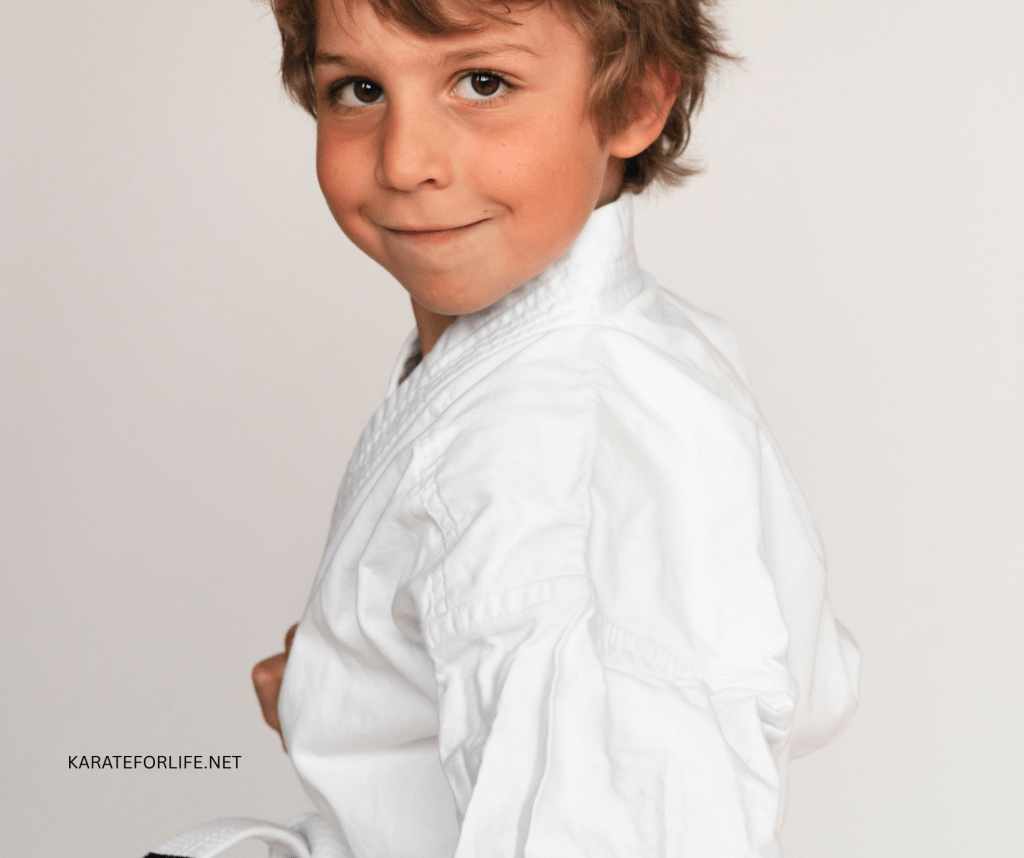
The quiet confidence that emerges from karate training isn’t the loud, performative kind. It’s not about feeling superior to others or needing to prove yourself. It’s the settled assurance that comes from knowing you’ve earned your progress through genuine effort.
When a child earns their next belt, they know—genuinely know—that they can do things today they couldn’t do six months ago. They have evidence of their own capacity to improve through persistent effort. That knowledge changes how they approach new challenges in other areas of life.
This isn’t confidence granted through participation trophies or inflated praise. It’s confidence built through real achievement: successfully performing techniques under pressure, helping newer students, pushing through the frustration of repeated failure until something finally clicks.
What This Actually Looks Like
Parents often notice changes before their children do. The kid who couldn’t sit still through dinner now practices kata in the backyard without being asked. The one who melted down at every setback starts problem-solving when techniques don’t work the first time. The child who needed constant external validation becomes more comfortable with internal standards of progress.
These aren’t overnight transformations, and they’re not universal. Every child progresses at their own pace. But the structure of traditional karate training creates conditions where these developments become possible—and with consistent practice, increasingly likely.
So yes, your child will learn kicks and punches. They’ll learn blocks and stances and kata. But what they’re really learning is how to focus, how to fail productively, how to persist through difficulty, and how to build genuine confidence through real achievement.
That’s what actually happens in karate class. And it’s considerably more useful than any individual technique they’ll learn.
 karateforlife.net